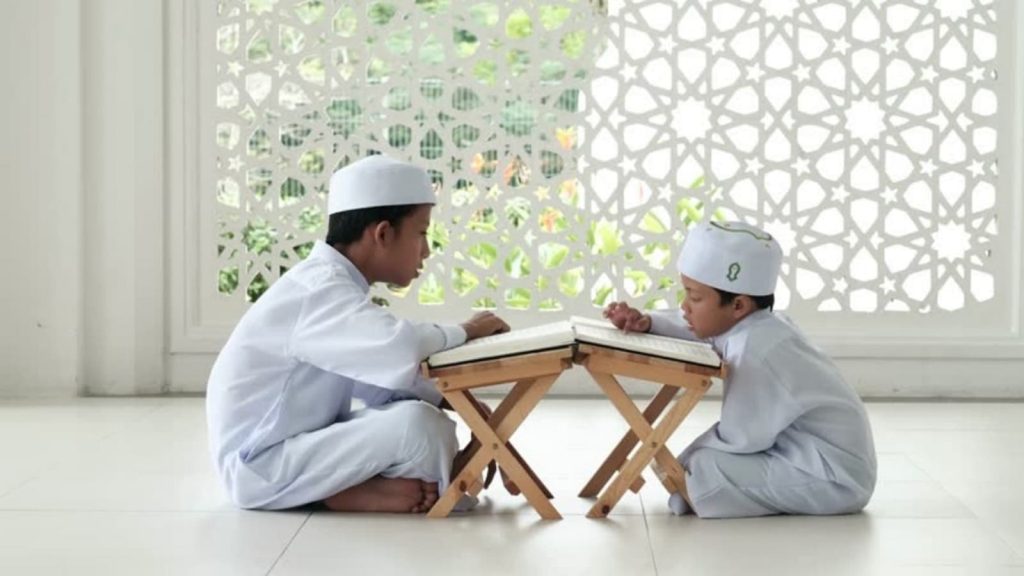
Introduction: Our Dream for Our Children
In the name of Allah, the Most Merciful, the Most Compassionate.
Brothers and sisters, fathers and mothers, those preparing for marriage, husbands and wives: this program has been prepared especially for you, so that you may realize your dream for your homes and your children, sons and daughters alike. They are the dearest part of yourselves, the comfort of your eyes, and the adornment of worldly life. Our children are our very hearts walking upon the earth; if the wind touches them, sleep flees from our eyes. Children may be your own children, or the children of your brothers and sisters, or the children of your neighbors and relatives, or the children entrusted to you in the institutions of education and life.
The wish of every father and mother is to have a righteous child who knows his Lord, honors his family, loves his homeland, serves his society, benefits himself, and benefits us through his supplication after we meet a Generous Lord while we remain in the earth until the Day of Judgment.
Within each of us is a deep desire and a great hope that our children will be among the finest people in this world, realizing themselves and their purpose, building their hopes and ambitions, and living a good and dignified life without needing anyone. We rejoice in them in this world and find happiness through them in the Hereafter.
لذلك كان دعاء الصالحين: ﴿رَبَّنَا هَبْ لَنَا مِنْ أَزْوَاجِنَا وَذُرِّيَّاتِنَا قُرَّةَ أَعْيُنٍ وَاجْعَلْنَا لِلْمُتَّقِينَ إِمَامًا﴾، وكان من دعاء أبي الأنبياء إبراهيم عليه السلام: ﴿رَبَّنَا لِيُقِيمُوا الصَّلَاةَ فَاجْعَلْ أَفْئِدَةً مِنَ النَّاسِ تَهْوِي إِلَيْهِمْ وَارْزُقْهُمْ مِنَ الثَّمَرَاتِ لَعَلَّهُمْ يَشْكُرُونَ﴾.
Thus the supplication of the righteous was: “Our Lord, grant us from among our spouses and offspring comfort for our eyes and make us an example for the righteous.” And among the supplications of Ibrahim, the father of the prophets, peace be upon him, was: “Our Lord, that they may establish prayer, so make hearts among the people incline toward them and provide them with fruits that they might be grateful.”
الأب والأم يتمزق قلبهما عندما يريان أولادهما يعيشون حياةً فاشلة، غير مدركين سرَّ وجودهم، والحياة تتسرّب من أيديهم؛ لذلك وقف أبٌ وأمٌّ يومًا في مقام الاستغاثة والضراعة إلى الله، وهما يخاطبان ابنهما: ﴿وَهُمَا يَسْتَغِيثَانِ اللَّهَ وَيْلَكَ آمِنْ إِنَّ وَعْدَ اللَّهِ حَقٌّ﴾.
The hearts of a father and mother are torn when they see their children living a failed life, unaware of the secret of their existence, while life slips from their hands. For this reason, a father and mother once stood in a state of pleading and humble supplication to Allah as they addressed their son: “while they call for Allah’s help: Woe to you! Believe. Indeed, the promise of Allah is true.”
Fathers and mothers work night and day, withholding nothing their children need: I gave my children the finest education, enrolled them in the best schools, fed them the best food, dressed them in the finest clothes, provided them with the best forms of enjoyment, and admitted them to the most established clubs. Then I say: I have done my duty and raised them in the best possible way!?
First: We Fall Short in Our Children’s Rights
One of us may take courses and programs in languages, computers, life skills, and perhaps even car maintenance, yet we do not think of learning the science of raising children. Some of us may imagine that we do not need it, or that upbringing is something instinctive, or an inheritance acquired from our parents. But not everything we inherited is sound, and not everything we learned is fit to be repeated as an exact copy. Our children must be raised for a time other than our own, and for a life other than our life. Upbringing is both a science and an art; it is not merely schools, clubs, food, drink, clothing, and entertainment. This is what we will learn in our program: how to realize our dream for our children.
Second: The Meaning of the Word “Upbringing”
We need to become acquainted with the meaning of the word “upbringing.” To understand its meaning, we must return to our beautiful Arabic language. Upbringing denotes increase and growth, emergence and flourishing, reform and preparation, and the fulfillment of responsibilities. In brief: raising children means building the human being gradually, step by step, until he reaches completion and maturity. Allah, Lord of the worlds, is the Lord of humankind, our Lord and the Lord of all people. He increased them, caused them to grow, brought them into being, and set them right gradually until they reached completion and maturity: a drop, then a clinging clot, then a lump of flesh, then bones clothed with flesh, then another creation brought into full form; then a fetus, then an infant, then a child, then an adolescent, then a mature young adult, then an elderly person. We want to learn from the divine method, for upbringing is the journey of a lifetime and a way of life.
Third: The Objectives of Raising Children
If upbringing is increase, growth, emergence, life, reform, and preparation, then this invites us to ask: increase, growth, emergence, and life – how? Reform and preparation – for what purpose? We must therefore define an objective for the upbringing we are discussing. The reason is that the education of the human being in communist societies made the individual a cog in a machine for the sake of the collective, with no regard for his personhood, dignity, hopes, or ambitions. In Western societies, the human being is raised to enjoy life to the utmost degree, because he does not believe in an afterlife or a second return. In Jewish societies, the human being is raised to take what does not belong to him. In capitalist societies, where the rich grow richer and the poor grow poorer, the human being receives a different kind of formation. For this reason, we will speak about upbringing in our Arab and Islamic societies. By Allah’s permission, we will speak about an Islamic, divinely guided upbringing that connects the human being to Allah: a comprehensive upbringing across all fields of life, balanced without excess or neglect, realistic in drawing from the past, benefiting from the present, and working for the future.
Fourth: Dimensions of Comprehensive Child Upbringing
We need to understand the dimensions of comprehensive, complete, and balanced upbringing, because deficient upbringing produces a distorted human being whose formation is incomplete. Have you seen a trainee in bodybuilding without a guide or coach? If upbringing is life, then it must encompass all of life’s domains: faith and morals, culture and society, vitality and beauty, homeland and identity, politics and economics, health and sport, sexuality and aesthetics. If upbringing is life, it must include every aspect of this life. That is why we said that the matter is greater than food, drink, and entertainment.
Fifth: Means of Raising Children
Upbringing has means and tools that help us achieve our objectives. Among them are living closely with children and keeping their company, example and role modeling, dialogue and discussion, stories and narratives, and reward and punishment; that is, giving every behavior an appropriate incentive and using reward and punishment well. Does punishment mean striking our children or not? Some say that beating is the only means that produces results!
Sixth: The Healthy Home Climate for Raising Children
Our homes need review. Our homes are our fortresses, and our fortresses are threatened from within, because the upbringing we hope for our children requires that certain qualities prevail in our homes: love and affection between fathers and mothers, tenderness and mercy toward children, dialogue and discussion, mutual respect, and understanding and acceptance.
Seventh: Rules for Raising Children
For upbringing to achieve its objectives, and after providing the proper climate, there are rules that must be respected and observed, including:
- Set right what is between you and Allah: “I set right what was between me and Allah, so He set right what was between me and people.”
- Set right what is between you and your spouse.
- Partnership between father and mother in raising children, away from one party’s domination and monopoly.
- Seek goodness and gradual progression in learning and acquisition: “Knowledge comes only through learning, forbearance only through training oneself in forbearance, and patience only through training oneself in patience.”
- Treat your child according to his age stage, always express your affection, and be neither excessive nor negligent.
- Time is part of the treatment.
Eighth: Etiquette of Guidance and Correction
In order to be granted success in raising your children, after understanding the meaning, objectives, qualities, and means of upbringing, and after adhering to a healthy climate and sound educational rules, you must observe the etiquette of guidance and correction, such as:
- Sincerity of intention.
- Truthfulness in action.
- Respect, not arbitrariness.
- Treatment, not wounding criticism.
- Facilitation, not making matters difficult.
- Concealment, not public exposure.
- Seeking excuses for others.
- Supplicating in their absence for good instead of supplicating against them in anger.
Ninth: Pitfalls in Raising Children
There are pitfalls that must be avoided, including:
- Excessive pampering.
- Excessive harshness.
- Overprotection.
- Domination and coercion.
- Making the child feel deficient, incapable, and weak.
- Entrenching signs of failure and frustration.
- Lack of love.
Tenth: The Psychological Needs of Our Children
We constantly make demands of our children, but what do our children need? What psychological needs must parents and society fulfill and satisfy so that our children grow into balanced and well-adjusted people?
- Love.
- Security.
- Appreciation.
- Acceptance.
- Success.
- Freedom.
- Knowledge.
- Recreation and enjoyment.
Eleventh: Age Stages in Raising Children
Our children pass through different age stages: infancy and the cradle stage, the preschool and kindergarten stage, early and late childhood, then early, middle, and late adolescence, followed by maturity and adulthood. Each stage has features and characteristics that we must know in order to understand our children and deal with them properly. Without understanding these stages, we will not be able to realize our dream for them. Examples include:
- The infant child’s attachment programming toward his mother.
- Possessiveness and ownership in the preschool child and at the beginnings of early childhood.
- Stubbornness and rebellion in the child of late childhood.
- The adolescent whom we force into a crisis because we do not understand him, pushing him toward the wrong path for expressing himself, because we do not realize that adolescence is a mixture of childhood and maturity in which a thing and its opposite come together.
- Laziness and lethargy.
Twelfth: Behavioral Problems and Their Treatment
We need to become acquainted with some behavioral problems among our children, how to deal with them, and how to offer practical solutions. Some people say: my son lies, my son is stubborn, my son is jealous… what should we do? The subject is broad. Take lying as an example: do you know that lying has types? There is imaginative lying, defensive lying, pathological lying, retaliatory lying, and pretentious lying… so which type does your child have, and why? Believe me, at the end of our program we will point you to the principle: “There is no such thing as a problem child; rather, there are problematic fathers and problematic mothers.”
Thirteenth: Raising Children in an Age of Transformations
We live in an age of transformations, challenges, major changes, and open cyberspace. This requires special preparation so that we can face the new challenges and variables.
Conclusion: Our Children Are a Trust
أولادنا أمانة، أولادنا وديعة، أولادنا خلفاء في الأرض: ﴿وَإِذْ قَالَ رَبُّكَ لِلْمَلَائِكَةِ إِنِّي جَاعِلٌ فِي الْأَرْضِ خَلِيفَةً﴾، فلنتعامل مع خلفاء آدم، الموكول إليهم عمارة الأرض بالخير.
Our children are a trust, our children are a deposit, our children are successors upon the earth: “And when your Lord said to the angels, Indeed, I will place upon the earth a successor.” Therefore, let us deal with the successors of Adam, those entrusted with cultivating the earth through goodness.
Await us, by Allah’s will, as we seek to realize our dream.
For more: see the Master’s Program in Education and more educational articles.